
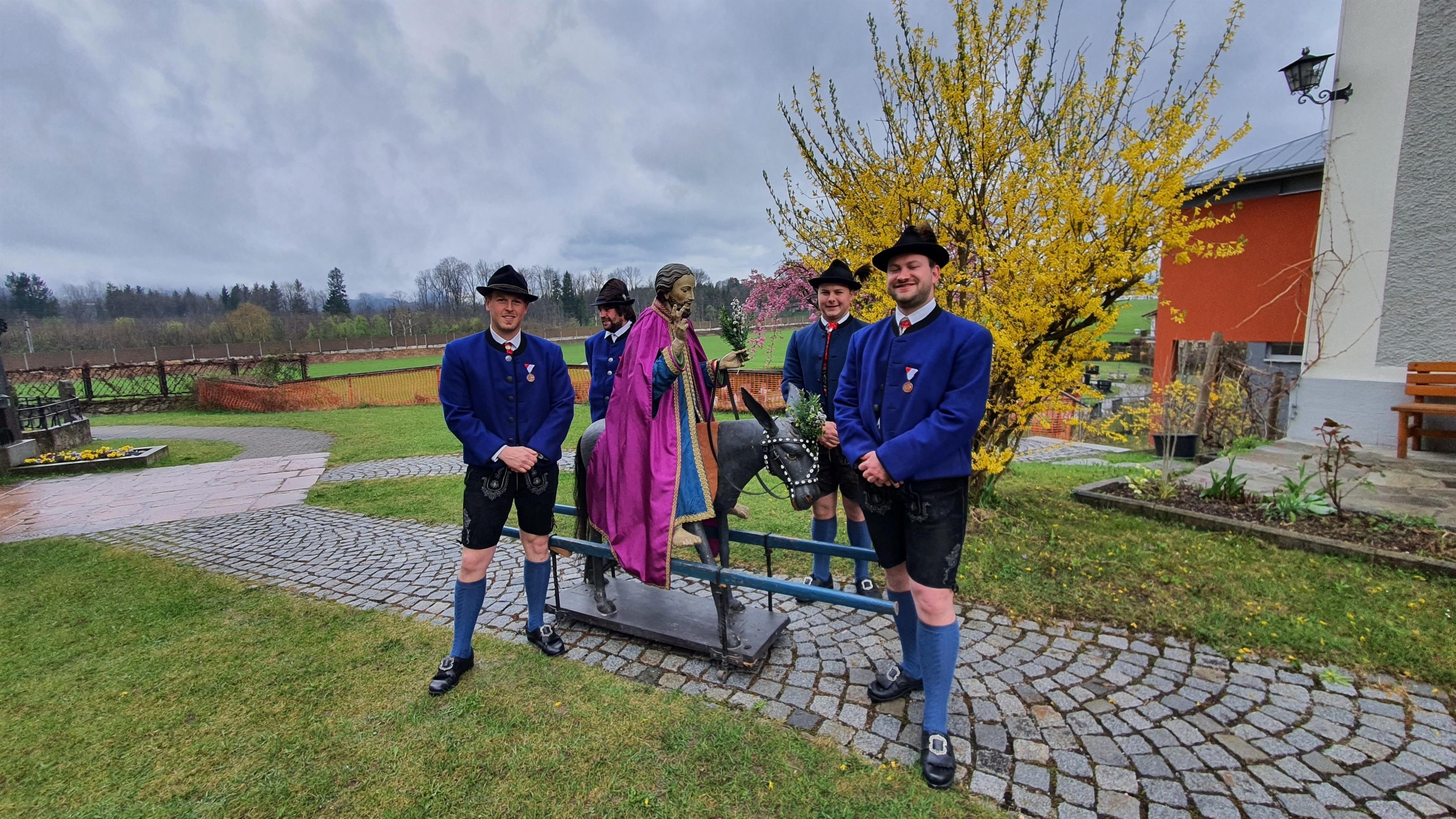

Palmesel
The fastest route to this destination
Palmesel
A unique Easter custom in AustriaEvery year on Palm Sunday in the Tennengau municipality of Puch near Hallein, the historic ‘Pucher Palmesel’ is carried through the village. The palm donkey is a figure carved out of wood with Jesus sitting on a donkey. During the year, the figure is located in the bell tower of Puch parish church and can be admired behind the secure bars.HISTORY: This ecclesiastical custom of ‘carrying the palm donkey’ used to be common in many places. It was not until 1785 that Archbishop Hieronymus Colloredo of Salzburg banned these palm donkey processions and all palm donkeys in the country had to be destroyed. However, the Puchers hid a 17th century palm donkey on a farm and so the donkey was able to survive. Since the 19th century, the palm donkey has once again been carried through the village in a solemn procession. This custom is unique in SalzburgerLand and enjoys great popularity.The palm donkey from Puch is 400 years old. Alongside a second wooden donkey in Thaur in Tyrol, it is now the last of the Easter processional figures that were once so popular in the Middle Ages and were used to bring the Bible stories closer to the non-reading population. The Puchers pulled the donkey with the blessing Christ out of the Salzach. During the Enlightenment, the popular figures were suddenly frowned upon. Archbishop Hieronymus Colloredo therefore had them banned in 1785.The Puch donkey, which probably originally came from Hallein, was therefore thrown into the river. It was rescued in Puch and hidden in the Koller farmer’s stable until it was allowed to take part in the procession again. He had to go into hiding again during the Nazi era. You can hardly see the wooden statue’s chequered history: With a bridle made from cowrie shells and a constantly renewed coat for the Christ figure, it has now found a home in the bell tower, where the donkey can be admired throughout the year until it makes its grand entrance on Palm Sunday. Further information on Easter customs in Puch can be found in the PUCH MAGAZINE at: www.puch-salzburg.com/en/magazine/pucher-palmesel-easter.htm
Jedes Jahr am Palmsonntag wird in der kleinen Gemeinde Puch bei Hallein der Palmesel durch den Ort getragen. Der Palmesel ist eine aus Holz geschnitzte Figur, wo Jesus auf einem Esel sitzt.
Dieser kirchliche Brauch war früher in vielen Orten üblich. Erst der Salzburger Erzbischof Hieronymus Colloredo untersagte 1785 diese Palmesel-Prozessionen und alle Palmesel im Land mussten vernichtet werden. Die Pucher aber versteckten einen aus dem 17. Jahrhundert stammenden Palmesel auf einem Bauernhof und so konnte der Esel überleben. Seit dem 19. Jahrhundert wird der Palmesel wieder in einer feierlichen Prozession durch den Ort getragen. Dieser Brauch ist einzigartig im SalzburgerLand und erfreut sich großer Beliebtheit.
400 Jahre alt ist der Palmesel von Puch. Er ist neben einem zweiten Holzesel in Thaur in Tirol mittlerweile der Letzte jener einst im Mittelalter so beliebten österlichen Prozessionsfiguren, mit denen man dem nicht lesenden Volk die Bibelgeschichten näher bringen wollte. Die Pucher haben den Esel mit segnendem Christus aus der Salzach gezogen. In der Aufklärung waren die volkstümlichen Figuren plötzlich verpönt. Erzbischof Hieronymus Colloredo ließ sie daher 1785 verbieten.
Der Pucher Esel, der ursprünglich aus Hallein stammen dürfte, wurde daher in den Fluss geworfen. In Puch hat man ihn geborgen und beim Kollerbauern im Stall versteckt bis er an der Prozession wieder teilnehmen durfte. Nochmals verstecken musste er sich während des Nationalsozialismus.
Die wechselvolle Geschichte sieht man der Holzstatue kaum an: Mit Zaumzeug aus Kaurimuscheln und einem immer wieder erneuerten Mantel für die Christusfigur hat er mittlerweile im Glockenturm Unterschlupf gefunden, wo der Esel das gesamte Jahr hindurch bewundert werden kann, bis er am Palmsonntag seinen großen Auftritt hat.
Address
All content has been researched by the editorial team to the best of their knowledge. However, the editorial team of Salzburger Verkehrsverbund GmbH cannot guarantee the completeness, accuracy, or timeliness of the information provided. We kindly ask you to verify the details when planning your trip, as opening hours, admission prices, or other information may change. Any liability claims against the editorial team or Salzburger Verkehrsverbund GmbH relating to material or non-material damages arising from the use of the information provided, or from the use of incorrect or incomplete information, are generally excluded.